
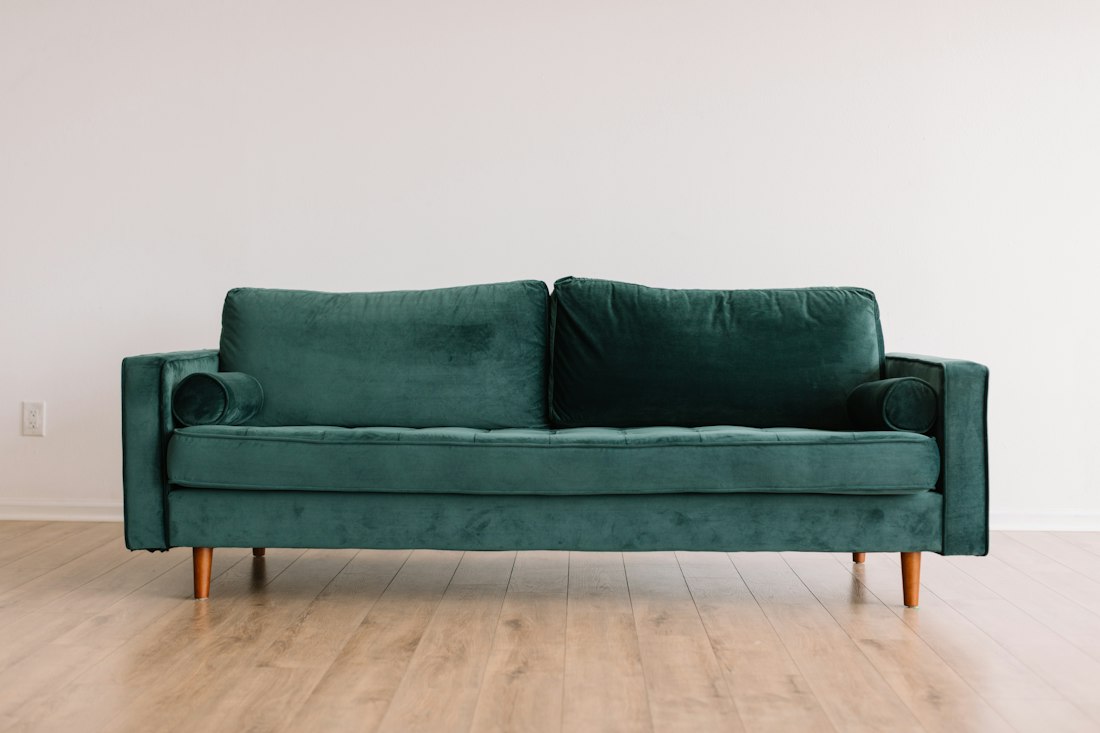
When you move into your first apartment after graduation or pick up the keys to a starter townhome, the living room is the space everyone sees first—and the room that takes the most daily wear. Over the past few years of helping friends and readers troubleshoot narrow North American floor plans (especially the classic 11-foot-wide townhome living room here in Edmonton and across Canada), I’ve noticed that almost every uncomfortable living room suffers from the exact same issue: every piece of seating is lined up against one wall staring at the television like a movie theater row.
When guests sit three across on a single sofa, nobody can make eye contact without twisting their neck. Below, we walk through how to break out of the “bowling alley” layout, how to balance a big black TV screen without custom millwork, and how to pick fabrics that survive pets, toddlers, and Friday night takeout.
Real-Room Walkthrough: Fixing the 11′×14′ Townhome Living Room
In most modern townhomes and two-bedroom condos, one long wall holds the TV hookup, the opposite long wall holds the sofa, one short end opens into the dining area, and the other short end leads to a patio slider or large window. If you push an oversized L-shaped sectional against the back wall, the chaise cuts off the patio door and leaves a giant empty patch of laminate flooring in the middle.
Here is the three-part layout adjustment that opens up the room:
- Step Down to an 80-Inch 3-Seat Sofa + Swivel Chair: Instead of a fixed sectional that locks your floor plan in place forever, anchor the long wall with an 80-inch track-arm sofa (pulled 3 inches off the drywall so curtains hang freely) and place a 30-inch round barrel swivel chair angled at 45 degrees toward the sofa.
- Keep the 16-Inch Coffee Table Reach: Measure 15 to 17 inches from the front edge of your sofa cushions to the edge of your coffee table. That distance is close enough to set down a mug without leaning forward, yet wide enough for your knees to pass comfortably.
- Tuck Two Woven Poufs Under the Media Console: Rather than crowding the walkway with a second permanent armchair, keep two 18-inch leather or braided wool poufs tucked under a floating TV console—pulling them into the circle only when four or five friends come over.
| Living Room Floor Plan | Room Dimensions | Recommended Seating Formula | Ideal Area Rug Size |
|---|---|---|---|
| Compact Condo Box | 10′ × 12′ (3.0m × 3.6m) | 74″–78″ apartment sofa + 1 armless accent chair + 32″ round coffee table | 6′×9′ or 8′×10′ (front legs on rug) |
| Long Narrow Townhome | 11′ × 16′ (3.3m × 4.9m) | 82″ sofa + 2 compact swivel chairs placed opposite or perpendicular + oval table | 8′×10′ (leaves 15″ border to walls) |
| Square Starter Home | 14′ × 14′ (4.2m × 4.2m) | 84″ reversible chaise sectional + 1 statement lounge chair + 36″ square ottoman | 9′×12′ (all seating anchored on rug) |
The Five-Texture Formula for Neutral Living Rooms
Many first-time decorators play it safe by buying a gray sofa, a gray polypropylene rug, gray curtains, and a gray throw blanket—and then wonder why the room feels cold during a six-month winter. You don’t need bright rainbow paint to warm up a neutral living room; you just need five distinct surface textures rubbing shoulders in the same space:
- 1. Nubby or Smooth Upholstery: Oatmeal bouclé, washed linen, or warm cognac leather (see our Apartment Sofa Guide for rub-count durability ratings).
- 2. Natural Underfoot Fiber: A looped wool blend, braided jute border, or vintage-washed flatweave rug that contrasts with smooth flooring.
- 3. Warm Wood Grain: Matte white oak or walnut on coffee table legs and picture frames (read How to Mix Wood Tones in a Room if your floors have a strong orange or gray cast).
- 4. Earthy Stone or Matte Ceramic: A fluted stoneware vase or honed travertine coaster stack on the coffee table.
- 5. Warm Brushed Metal: Antique brass or matte black iron on your floor lamp neck and curtain rods.
What to Look For in a 360-Degree Swivel Barrel Accent Chair
When shopping for a living room accent chair that bridges an open-concept kitchen and sofa zone, look for a heavy steel 360-degree swivel base concealed inside a cylindrical plinth, a curved barrel back that doesn’t block window sightlines, and stain-resistant performance bouclé or micro-velvet fabric.
How to Disguise the Big Black Television Rectangle
A 55- or 65-inch powered-off television is essentially a giant black mirror that sucks the warmth out of your main focal wall. Instead of letting the TV sit alone in the middle of bare white drywall, try one of these three designer fixes:
- Choose a Console at Least 12 Inches Wider Than the Screen: A 55-inch TV measures roughly 48 inches wide horizontally. Pairing it with a 60-to-70-inch media console leaves 6 to 10 inches of breathing room on each side so the screen looks grounded rather than top-heavy.
- Build an Off-Center Gallery Grouping Around It: Hang three or four oak-framed prints around the top and side of the television (see our Modern Wall Decor Guide) so the black screen reads as just one frame inside a larger composition.
- Add Asymmetrical Height on the Console: Place a tall ceramic vessel filled with dried olive or eucalyptus branches on one end of the media cabinet and a low stack of two linen-bound books with a warm 2700K lamp on the other.
Related Living Room & Small-Space Guides:
Common Questions About Living Room Styling
How many throw pillows actually belong on a standard 3-seat sofa?
Four pillows is the sweet spot: place one 22″×22″ textured square pillow in each corner, paired with a slightly smaller 18″×18″ or lumbar cushion tucked in front. More than five pillows means guests have to move cushions onto the floor just to sit down.
Should my coffee table and media console be the exact same wood finish?
No—matching every wood surface makes a room feel flat. If your media console is warm walnut or white oak, choose a coffee table with a contrasting material like honed travertine, tempered glass, or an upholstered storage ottoman.
How do I light a living room that has no ceiling light fixture at all?
Many older apartments and concrete high-rises have no central ceiling light in the living room—only a wall switch wired to a single half-hot wall outlet. Plug a tall arc or torchiere floor lamp into that switched outlet, then add two table lamps on smart plugs grouped in your phone app so all three lamps turn on together with a single tap.