
Quick Wood-Mixing Notes
- Match the Undertone, Not the Exact Stain: Wood finishes don’t need to be the same lightness or darkness—they just need to share a warm, cool, or neutral undertone.
- Use an Area Rug as a Buffer: If your wood coffee table or dining table is slightly different from your hardwood floor, slipping a textured rug between them prevents the two woods from competing directly.
- Repeat Each Wood Tone Twice: Whenever you introduce a darker accent wood (like walnut in a white-oak room), echo it in at least one other spot—such as picture frames or a lamp base.
When you’re furnishing a first home or apartment on a realistic budget, you rarely buy every piece of furniture on the same day from the same collection. Maybe you inherited a vintage walnut dresser, bought a light white-oak coffee table online, and moved into a condo with honey-toned or gray-washed laminate flooring. Trying to match every wood stain identically usually backfires—leaving the room looking either like a rigid catalog showroom or a series of “near-misses.”
Interior stylists deliberately combine two to three distinct wood tones in every room. Here is how to make mixed woods look effortless and intentional.
1. Step 1: Identify Your Floor’s Undertone
Because your flooring is the largest wood surface in the room, look closely at its base hue in natural daylight:
| Wood Undertone Family | Common Wood Species & Finishes | Pairs Best With | What to Avoid |
|---|---|---|---|
| Warm Undertones (Yellow, Honey, Orange, Red) | Honey oak, cherry, teak, warm pine, golden acacia | Classic walnut, warm white oak, aged brass, cream & olive textiles | Icy gray-washed barnwood (makes warm floors look overly orange) |
| Cool Undertones (Gray, Ashy, Silver-Taupe) | Gray laminate (common in 2015–2022 condos), weathered ash, espresso | Matte black-stained oak, pale ash, neutral walnut, brushed nickel | Red-toned mahogany or bright orange pine |
| Neutral Undertones (Balanced Beige/Brown) | Natural white oak, American walnut, birch, beech | Almost any warm or cool wood! White oak and walnut are universal bridges | Overly glossy polyurethane finishes mixed with raw rustic wood |
2. Step 2: Apply the 70 / 20 / 10 Wood Ratio
Just like our overall 70/20/10 home decor style rule, divide your wood finishes by visual weight:
- 70% Dominant Wood Tone: Your flooring plus one major anchor piece (such as a dining table or media console).
- 20% Medium Contrast Wood: A secondary wood that is clearly lighter or darker than the dominant tone (for example, pairing warm walnut side tables with pale white oak floors).
- 10% Accent Wood or Burl: Small decorative touches—like solid oak gallery frames, an olive-wood bowl, or a rattan pendant shade.
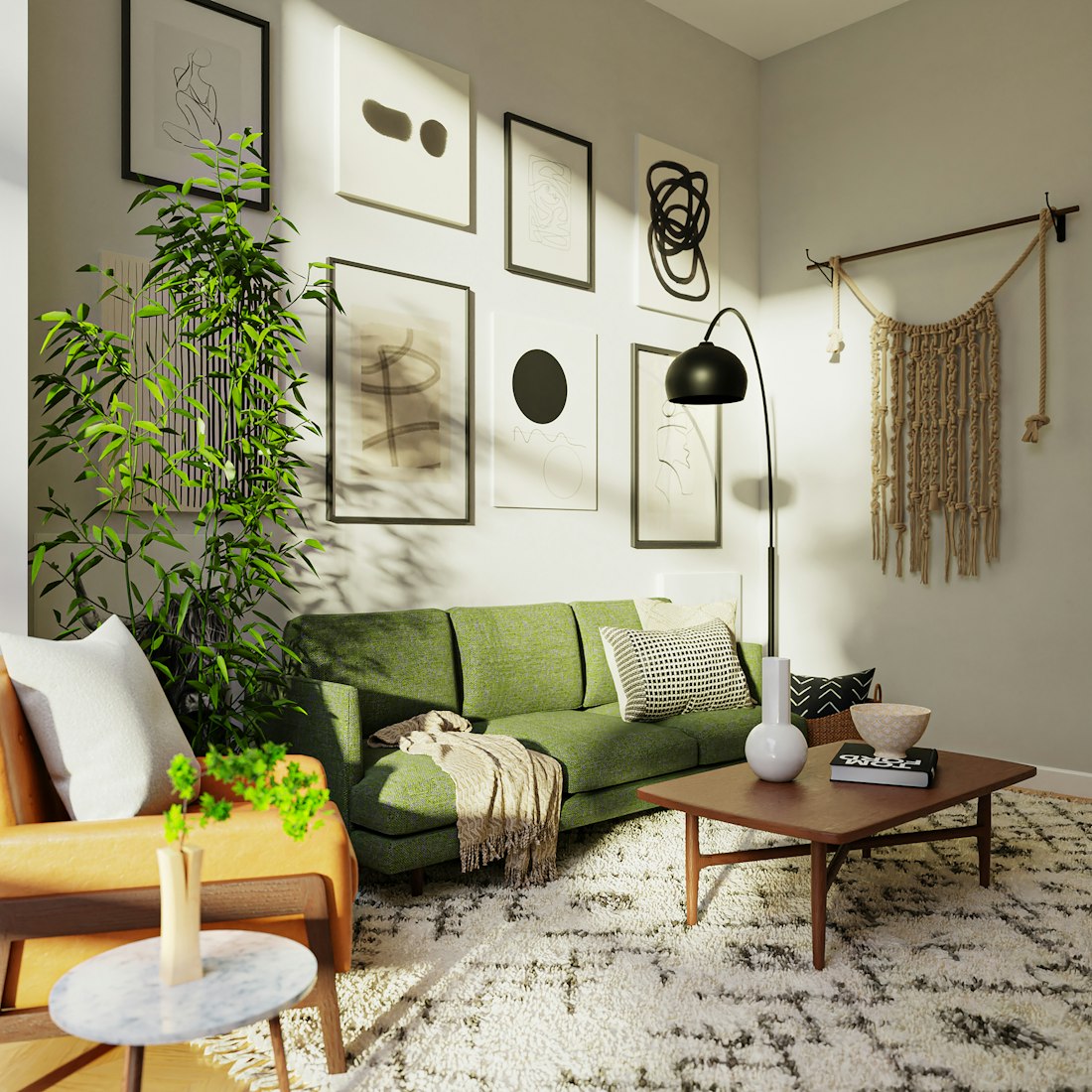
Textured Wool/Jute Area Rug + Solid Oak Picture Frames
Laying an oatmeal or vintage-patterned rug over tricky rental flooring creates a neutral canvas so your wood furniture legs never clash with the floor boards. Repeating your secondary wood tone in two 24″×36″ frames on the wall ties the whole room together.
3. Break Up Wood Surfaces With Upholstery, Stone & Metal
If a dining room has wood floors, a wood table, six wood chairs, and a wood sideboard, the space feels like a lumber yard—even if the stains match. Break up wood-on-wood contact by choosing upholstered bouclé or matte black spindle dining chairs, topping a wood sideboard with a travertine tray or ceramic lamp, and hanging a linen pendant overhead.
Explore Related Styling Guides:
Common Questions About Mixing Wood Tones
How do I decorate around gray laminate rental floors so my apartment still feels warm?
Cover 60% to 70% of the gray laminate with a large warm-toned area rug (ivory, oatmeal, camel, or muted terracotta), choose neutral walnut or matte black wood furniture rather than yellow pine, and use 2700K warm lamp bulbs to counteract the cool gray floor.
Does black-stained wood count as a wood tone?
In interior design, matte black-stained oak or ash acts like a grounding neutral (similar to wrought iron) rather than a competing wood stain. Adding one black-stained accent table or frame is one of the easiest ways to calm down a room that already has two other wood tones.