

Walk down the drapery aisle of any home store and you’ll see rows of curtain packages labeled “84 Inches Long — Standard.” Naturally, millions of first-time homeowners and renters buy two 84-inch grommet panels, screw the brackets directly into the top corners of their wooden window casing, and hang them up. The result? The curtains stop 5 inches above the baseboards like flood-water pants, visually chop the wall height in half, and cover a third of the glass even when pulled open.
Curtains are the architectural frame for your room’s natural light. By changing where you drill four bracket screws and stepping up one standard panel length, you can make a standard 8-foot apartment ceiling feel like a 9.5-foot loft—and gain up to 30% more winter daylight.
1. The “High and Wide” Curtain Rod Mounting Formula
Before measuring for curtain panels, mark where your curtain rod will actually live on the drywall—not on the window trim itself:
- Mount 4 to 6 Inches Below the Ceiling (or Crown Molding): In a standard 8-foot (96-inch) room where the top of the window frame sits 14 inches below the ceiling, mounting your brackets 4 inches below the ceiling draws the human eye all the way up the wall.
- Extend the Rod 8 to 12 Inches Past Each Side of the Window Frame: This is called “stackback.” When you open your curtains during the day, the fabric folds need somewhere to sit. By extending the rod 8 to 10 inches onto the blank drywall on both sides of the window, the open curtains rest over the drywall with only their inner edge kissing the window trim—leaving 100% of your window glass uncovered to let in sunlight!
| Ceiling Height | Rod Mounting Height from Floor | Standard Store Curtain Length to Buy | Hem / Ring Adjustment |
|---|---|---|---|
| 8-Foot Ceiling (96″) | 91″–92″ from floor (4″–5″ below ceiling) | 95″ or 96″ panels (Skip 84″!) | Hang from ring clips + hem 3″ with iron-on tape so fabric kisses the floor |
| 9-Foot Ceiling (108″) | 102″–104″ from floor | 108″ panels | Hang on drapery rings so bottom hem skims 1/4″ above hardwood |
| Low Basement / Bulkhead (86″–88″) | 83″–84″ from floor (ceiling-mounted track or high bracket) | 84″ panels | 84″ panels finally hit the floor properly when hung right under an 85″ bulkhead |
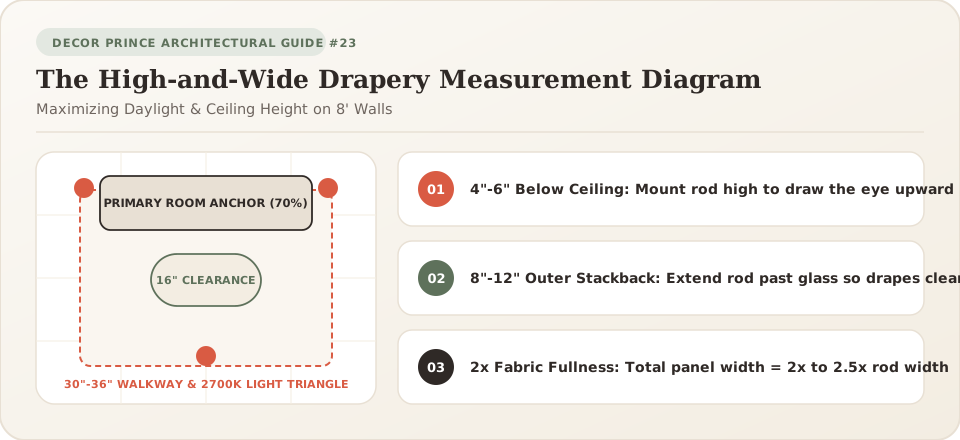
2. The 2× Width Fullness Rule (Why Two Skinny Panels Look Cheap)
Have you ever closed a pair of curtains at night and noticed they stretch completely flat across the window like a bedsheet taped to the glass? Even when closed, curtains should still have soft, vertical wave folds.
To get that tailored look, the combined flat width of all your curtain panels must equal 2 to 2.5 times the total width of your curtain rod:
- Suppose your window is 60 inches wide, and you extend your rod 10 inches on each side—giving you an 80-inch curtain rod.
- Multiply 80 inches × 2 = 160 inches of total fabric width needed.
- Since standard off-the-shelf curtain panels measure 50 inches wide each, two panels only give you 100 inches (too flat!). Instead, buy four 50-inch panels (hanging two panels on the left and two on the right) or order double-wide 100-inch panels so your drapery always looks plush and full.
What to Look For in Curtain Headers, Rods & Ring Clips
Skip thin 1/2-inch telescoping rods that bow in the middle under the weight of linen panels, and avoid metal grommet-top curtains. Choose pinch-pleat, euro-pleat, or hidden back-tab panels hung from smooth-gliding drapery rings—and use a $5 roll of iron-on hem tape to tailor 96-inch panels to kiss your floor cleanly without a sewing machine.
3. How to Steam & Train New Curtains so Folds Hang Straight
Straight out of the package, linen and cotton curtains are full of stiff horizontal box creases. Once hung, run a handheld garment steamer slowly from top to bottom, then fold the panels into neat vertical accordion pleats while still slightly warm and damp. Tie a loose strip of soft fabric ribbon around the middle and bottom of each gathered stack for 48 hours; when you untie them, the curtains will hold crisp, vertical designer folds permanently.
Explore Related Room & Budget Guides:
Common Questions About Measuring & Hanging Curtains
Should curtains kiss the floor, float above it, or puddle on the floor?
For everyday North American homes—especially with robot vacuums, pets, or winter dust—the “floor kiss” or 1/4-inch float is ideal. Puddled curtains (adding 2–4 extra inches on the floor) trap pet hair and dust bunnies and look messy whenever you open and close the drapes daily.
What if I have a baseboard heater or radiator directly under my window?
Never drape long fabric curtains over an active electric baseboard heater (a serious fire hazard). Either install inside-mount Roman shades or cellular blinds that stop safely at the window sill, or hang stationary decorative curtain panels only on the outer drywall sides of the window if the heater doesn’t extend past the frame.